
Regulating Forest Carbon: A Three-Act Saga
Act I — The Birth of a Label, the Birth of a Framework
It all began in France. In 2018, at a time when major European climate regulations had not yet been introduced, France created the Low Carbon Label: a national standard for certifying carbon reduction and sequestration projects, verified by an independent auditor and recorded in a public register. A pioneering tool, ahead of its time.
The first chapter of our story: the French framework — the one in which the LBC was born, and which continues to shape it.
The BEGES: a requirement that opens doors
Any company with more than 500 employees must carry out a greenhouse gas emissions inventory (BEGES) every four years, in accordance with Article L229-25 of the Environment Code. This BEGES covers Scopes 1, 2 and significant indirect emissions (Scope 3), and must be accompanied by a mandatory transition plan setting out the objectives, means and actions for reducing emissions.
The Low Carbon Label (LBC) can complement this process. This transition plan may, on a voluntary basis, include the purchase of LBC carbon credits as a measure to further support direct reduction efforts.
For companies without prior international climate commitments, the BEGES often constitutes the first key step towards initiatives such as the LBC, legitimising a responsible approach from the outset through legal obligation.
SNBC 3: the LBC, the official channel for national emergencies
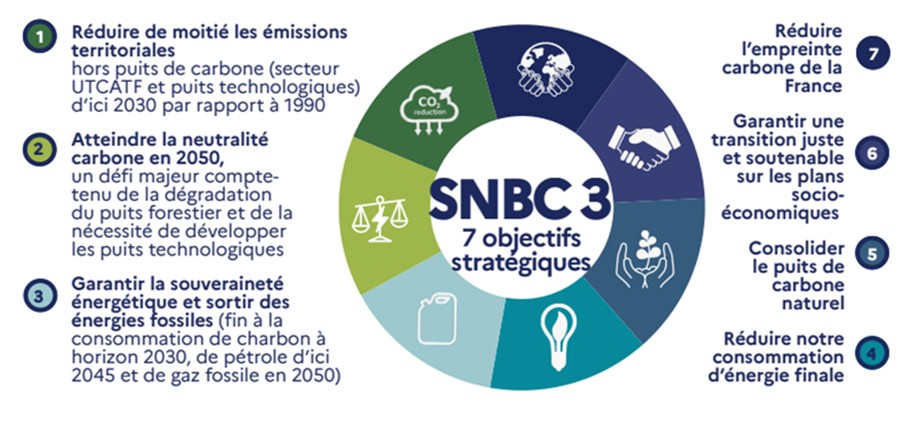
Published in late 2025, the National Low-Carbon Strategy (SNBC 3) sets out France’s climate pathway. For forests, the situation is alarming: the forest carbon sink has halved in ten years due to droughts, tree decline and insufficient regeneration. The aim is to restore it to around 18 MtCO₂ absorbed per year by 2030.
The Low Carbon Label is an official instrument: the decree of 5 September 2025 defines it as a “tool for implementing the national low-carbon strategy”. LBC afforestation projects finance the acceleration of forest regeneration called for by SNBC 3, through private capital.
Purchasing LBC forest carbon credits means contributing to a national objective that is measurable, verifiable and enshrined in law.
‘Carbon neutral’: France takes the lead
Since 1 January 2023, the Climate and Resilience Act has prohibited any company from claiming that a product or service is “carbon neutral” — or using any equivalent wording (“zero carbon”, “100% offset”, etc.) — without publishing a public report justifying the full GHG balance (life cycle), the reduction trajectory and the verified residual offsets. Penalties: up to €100,000 for a legal entity. Low Carbon Label forestry projects explicitly meet the requirements of this law regarding the offsets used.
The LBC decree of 5 September 2025 goes further with Article 30, which sets out common principles for all uses of credits: explicitly naming the funded project, mentioning the reduction actions already undertaken by the company, and never giving the impression that funding credits is equivalent to a reduction in the company’s own emissions. These rules aim to ensure transparency and prevent the LBC from becoming a mere tool for greenwashing. Communication must remain proportionate to the actual commitment and form part of a comprehensive climate strategy: measure, reduce — then contribute or offset. Only the forestry project is certified, not the company or its product.
📌 Key points
- The LBC was launched in 2018 — before the major European requirements came into force. In a sense, it paved the way for them.
- The BEGES requires companies with more than 500 employees to produce a climate action plan every four years: this plan may, on a voluntary basis, include the purchase of carbon credits certified under the Low Carbon Label (LBC) as a supplementary contribution to emission reduction measures.
- The SNBC 3 aims to restore the forest carbon sink to -18 MtCO₂/year by 2030: the LBC is one of its official tools.
- Since 2023, claiming to be ‘carbon neutral’ without a GHG inventory or reduction pathway has been prohibited in France — the LBC strictly regulates the communications of its purchasers (Art. 30).
→ In the next episode: Europe takes centre stage. CSRD, anti-greenwashing, mandatory reporting… the European framework is catching up with France — and confirms what LBC had already realised.
Sources: Order of 5 September 2025 defining the Low Carbon Label framework (Articles 3 and 30) · SNBC 3 draft (December 2025) · Law No. 2021-1104 on Climate & Resilience + Decrees Nos. 2022-538/539 · Practical Guide to Environmental Claims, CNC (March 2023)