
SBTi V2: reducing emissions and restoring forests
The role of forests in carbon sequestration raises a question that is frequently discussed within companies, and one that has become all the more pressing following summers marked by repeated heatwaves: should we be funding forests as well as reducing our emissions, or is this merely a PR exercise? Reducing emissions remains, without question, the top priority.
The new version of the benchmark climate standard, the SBTi Corporate Net-Zero Standard V2.0, published on 11 June 2026, provides a clear answer to this question. It deserves to be explained simply, without jargon, because it changes the way we think about the carbon contribution of forests.
(SBTi = Science Based Targets initiative: the international organisation that validates companies’ climate targets.)
1. Rule number one: reduce first
The standard is unambiguous: the priority is to reduce one’s own emissions – those from operations (Scopes 1 and 2) and those from the value chain (Scope 3). In this regard, carbon credits do not count: one does not ‘offset’ a reduction target; one meets it by actually decarbonising.
This point is essential to dispel a common misconception: supporting forests is never a substitute for reduction. It is not a substitute. This is the exact wording used by the standard: the contribution is a complement, never a substitute.
2. That leaves residual emissions, and that is where the forest comes in
Even when emissions are reduced as much as possible, a company continues to emit for years: these are its residual (‘ongoing’) emissions.
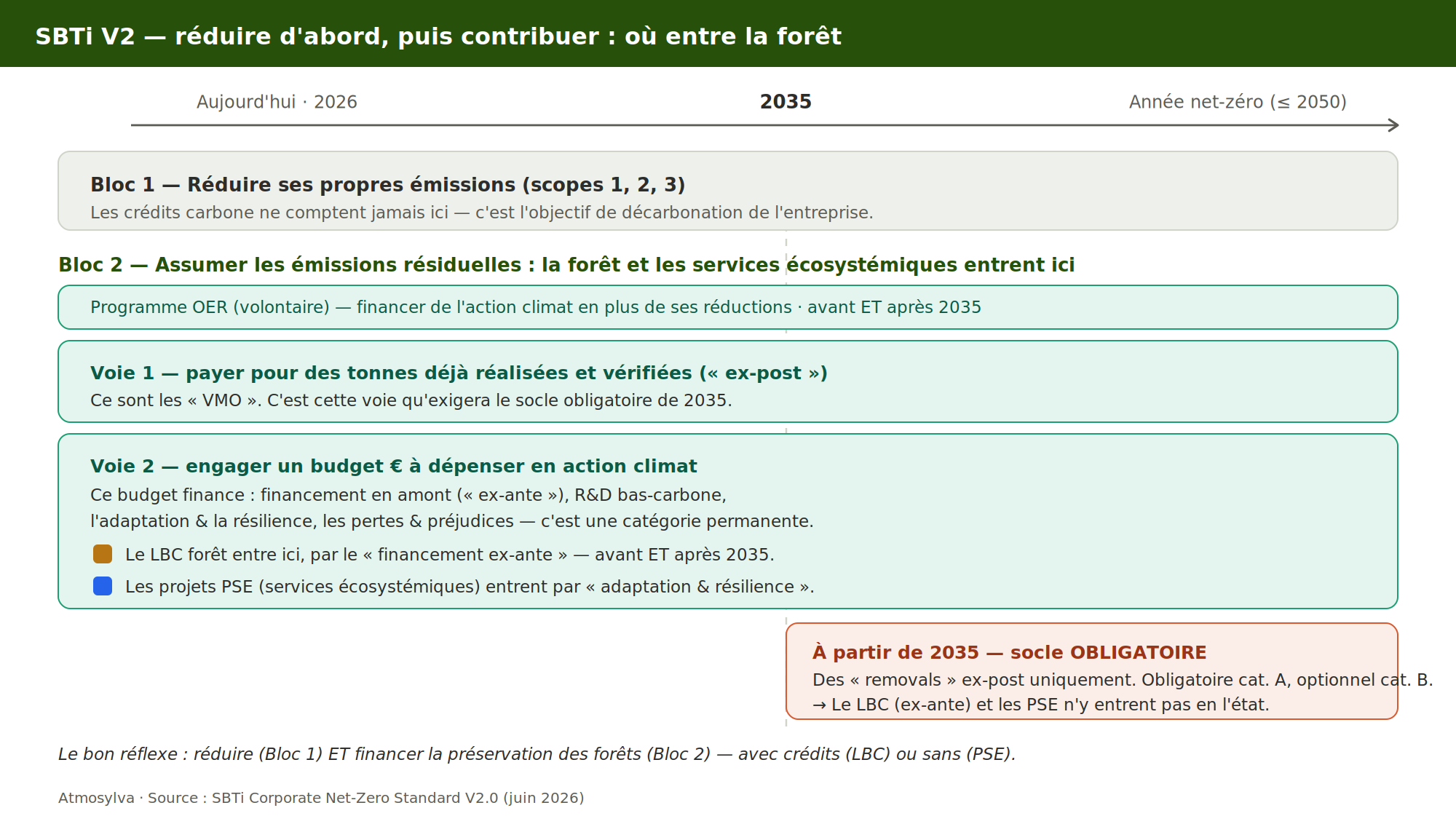
The V2.0 standard establishes a dedicated mechanism to take responsibility for these: the OER (Ongoing Emissions Responsibility) programme. It is voluntary and publicly recognises companies that fund climate action in addition to their own emissions reductions.
3. Forest carbon offsetting: two ways to contribute
The OER programme offers two options:
- Option 1 — paying for tonnes that have already been achieved and verified (known as ‘ex-post’). These are verified mitigation outcomes (VMO).
- Option 2 — committing a contribution budget, an amount in euros to be spent on climate action. This budget can fund upstream (‘ex-ante’) financing, low-carbon R&D, adaptation and resilience, or even loss and damage.
Recognition is categorised into three levels: Engaged, Advanced and Leadership, depending on the proportion of emissions covered.
Where do French forests stand? Credits under the Low-Carbon Label (LBC) operate on an ex-ante basis: funding today supports expected reductions and removals over the course of the project. They therefore naturally fall under Track 2, via ‘ex-ante financing’. An ecosystem services project (PSE – water, biodiversity, soil), on the other hand, falls under the ‘adaptation and resilience’ category of this same Track 2.
4. The timeline: before and after 2035
This is the key point to understand clearly, as this is where oversimplifications creep in:
Up to 2035: both pathways remain open. Ex-ante financing for forests is fully recognised.
From 2035 onwards: a mandatory baseline will be introduced for Category A companies (see below): verified ex-post carbon removals will then be required. Ex-ante financing is not sufficient to meet this baseline requirement.
However, Pathway 2 does not disappear: ex-ante financing, R&D, adaptation and resilience remain recognised climate actions under the voluntary scheme, both before and after 2035. This is a permanent category.
In other words: support for forests remains recognised throughout; it is only the 2035 obligation that additionally requires ex-post removals.
5. Category A or B: your obligations are not affected in the same way
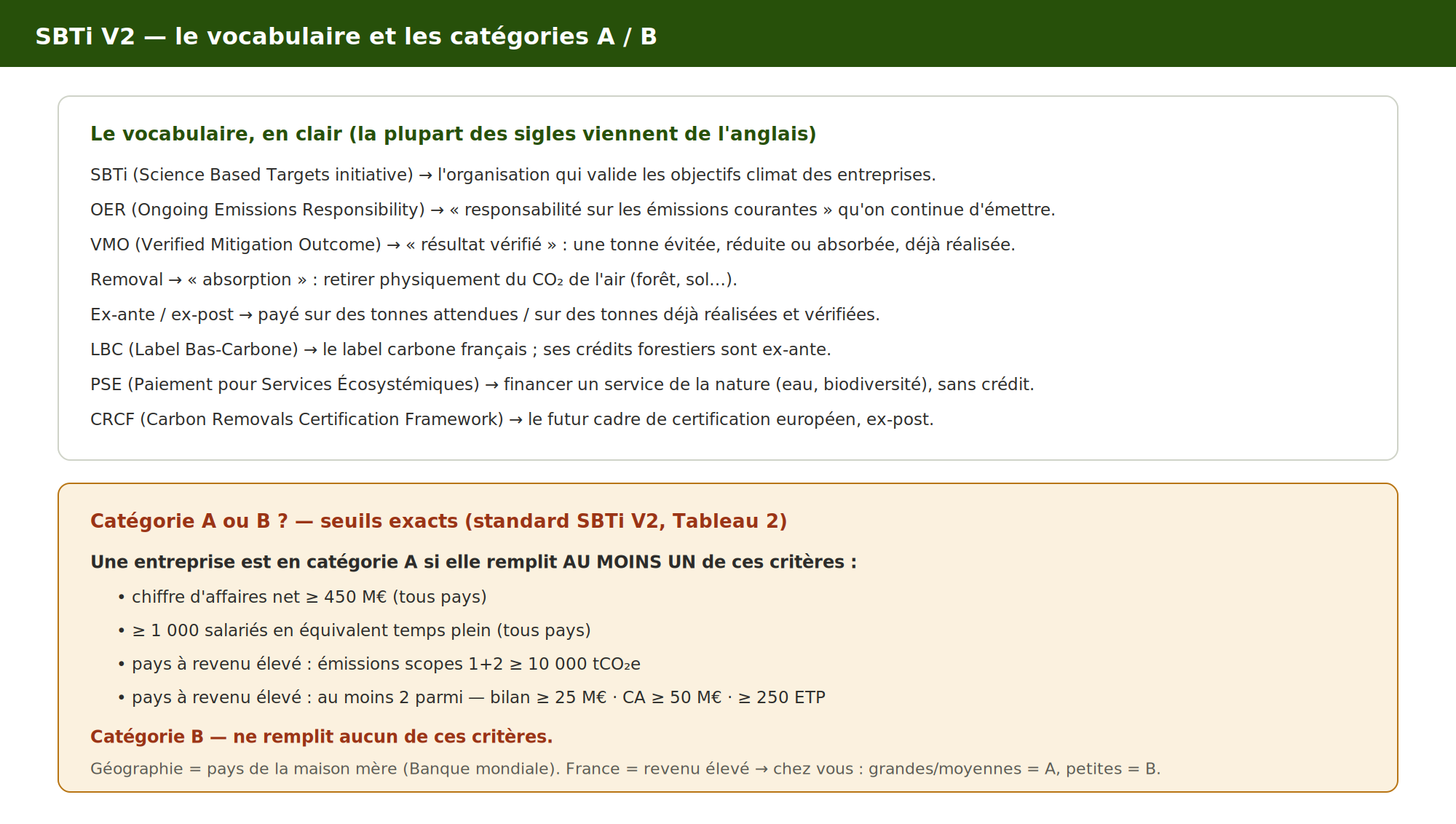
The standard classifies companies into two categories, based on their size and country. A company is classified as Category A if it meets at least one of the following criteria:
- net turnover ≥ €450 million
- ≥ 1,000 employees (across all countries);
- for a high-income country such as France, Scope 1+2 emissions ≥ 10,000 tCO₂e, or at least two of the following criteria: balance sheet total ≥ €25 million, turnover ≥ €50 million, ≥ 250 employees.
The others fall into category B.
As a direct consequence, the 2035 ex-post offset requirement applies to Category A; it remains optional for Category B. For an SME (Category B), the forestry contribution therefore remains a matter of choice, with no future ex-post obligation.
6. Why this calendar champions the forest
Read carefully, and version 2.0 reinforces the importance of taking action to protect our forests, without exaggeration:
- Adaptation and resilience are recognised, enduring concepts. Yet regenerating and restoring forests affected by drought, dieback or fire is, in precisely this sense, adaptation. Forests are a major solution to climate change, but they are also under pressure: funding them to help them regenerate is an adaptation measure, not a cosmetic gesture.
- The 2035 ex-post shift is a reason to act now. Building up a reserve of high-quality French forestry projects takes years: time for growth, verification and alignment with the future European framework (CRCF). Providing support today means building the supply of credible carbon sinks for tomorrow.
- Reduction and restoration are not mutually exclusive. Reduction tackles a company’s emissions; restoration addresses the residual emissions and funds a threatened living carbon sink. Rejecting the latter does not make the former any more sincere.
7. With or without loans: two ways to finance forestry
This is the distinction we must bear in mind:
- on the one hand, reduction targets: decarbonising the company itself;
on the other, funding forest conservation, which can be achieved either through certified carbon credits (the LBC, a state-backed label audited by a third party) or without credits (sponsoring plantations and payments for ecosystem services).
Atmosylva supports both approaches: an LBC-certified contribution recognised under the SBTi framework, for companies that require it; and direct funding for forests and their ecosystem services, for those who simply wish to take action, outside the carbon credit system.
In summary. The standard does not say ‘reduce, then keep quiet’. It says: prioritise reduction, and take responsibility for your residual emissions by funding high-quality climate action. For France’s forests, which are under pressure, this funding is not merely a PR exercise: it is essential if they are to remain a solution in the future.
Atmosylva designs and manages forest projects certified under the Low-Carbon Label and ecosystem services projects, acting as a direct link between the forest owner and the funding company. To discuss this further.
Sources: SBTi Corporate Net-Zero Standard V2.0 (sciencebasedtargets.org, 11 June 2026), Articles C40 to C46 and Table 2 (categories). Label Bas-Carbone (forestry methods, ex-ante). CRCF — Regulation (EU) 2024/3012 (ex-post certification).