Public procurement and climate commitments: local anchoring as a way to stand out
On 30 September 2026, the Produrable trade show held a conference on a question that has become central: “Local anchoring: what territorial responsibility for companies?”. Relocation, citizens’ expectations, social acceptance: companies are expected to demonstrate their local contribution and their territorial anchoring. The conference also raised the question of indicators: “how can a company’s contribution to its territory be measured in practice?”
Public procurement and climate frameworks point in the same direction. Companies that take root in the area where they operate will be one step ahead. The forest offers a concrete, measurable and visible way to do so.
1. What public procurement and climate frameworks require
1.1. Public procurement
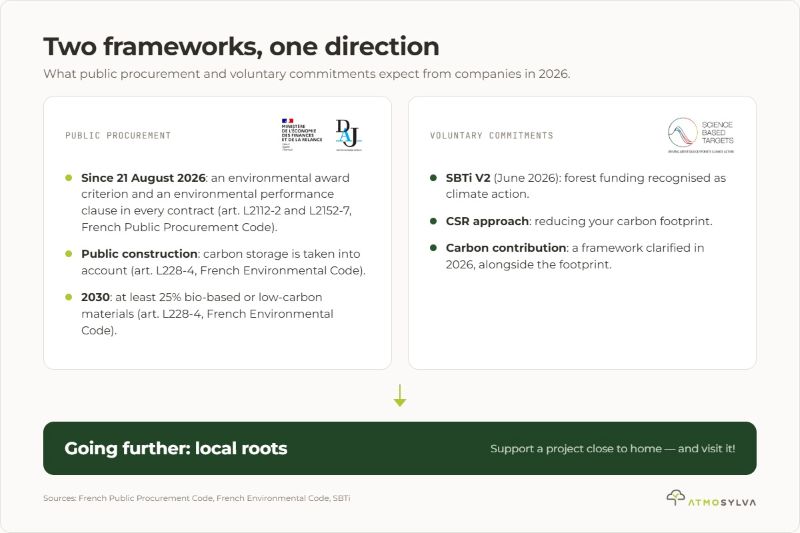
Since 21 August 2026, every public contract in France must include an environmental award criterion and an environmental performance clause. This results from Article 35 of the Climate and Resilience Act, which amended the French Public Procurement Code. Price can no longer be the sole award criterion.
The environmental criterion applies to the bid. It must be linked to the subject matter of the contract, at any stage of its life cycle: raw materials, production, transport, use, end of life. The Code explicitly lists biodiversity among the elements that award criteria may cover.
For public construction, the French Environmental Code goes further. Its Article L228-4 provides that public procurement “takes into account the requirements of combating greenhouse gas emissions and of carbon storage”. From 1 January 2030, bio-based or low-carbon materials must be used in at least 25% of major renovations and public construction projects.
1.2. Companies’ voluntary commitments
Beyond public procurement, more and more companies are committing to voluntary climate initiatives.
The new SBTi standard, published in June 2026, recognises forest financing as a climate action in its own right, alongside emission reductions. We covered this in detail in our article SBTi V2: reducing emissions and restoring forests.
The framework for forest carbon contribution was also clarified in 2026. Carbon credits do not reduce a company’s carbon footprint: they sit alongside it. We explain this in French forests: a carbon opportunity within a clarified framework, and in more detail in Forest Magazine No. 1.
Two frameworks, one direction
2. An example: timber construction
Timber construction is a good illustration of how a company can meet both frameworks.
In public procurement, timber provides concrete evidence for the environmental criterion, the performance clause and the requirements of Article L228-4 of the Environmental Code.
In the private sector, it supports commitments to reduce carbon footprint: CSR approach, SBTi pathway.
Fibois Île-de-France, the regional interprofessional body for the forest-wood sector, highlights several advantages:
- Carbon: timber stores carbon and cuts construction-site emissions by at least half compared with concrete (Carbone 4).
- The worksite: dry construction process, prefabrication, less disruption. 75% of waste is recovered.
- Use: thermal and acoustic insulation, a light and recyclable material.
- Origin: PEFC and FSC certifications guarantee sustainable forest management.
Timber also creates a direct link with the forest it comes from. This is where some companies choose to go further.
3. Going further: local anchoring as a way to stand out
Meeting requirements is now expected. Standing out means going beyond them, voluntarily. In a public contract, this commitment will not be scored: it is made outside the bid. That is precisely what gives it meaning. The company acts because it is rooted in a territory.
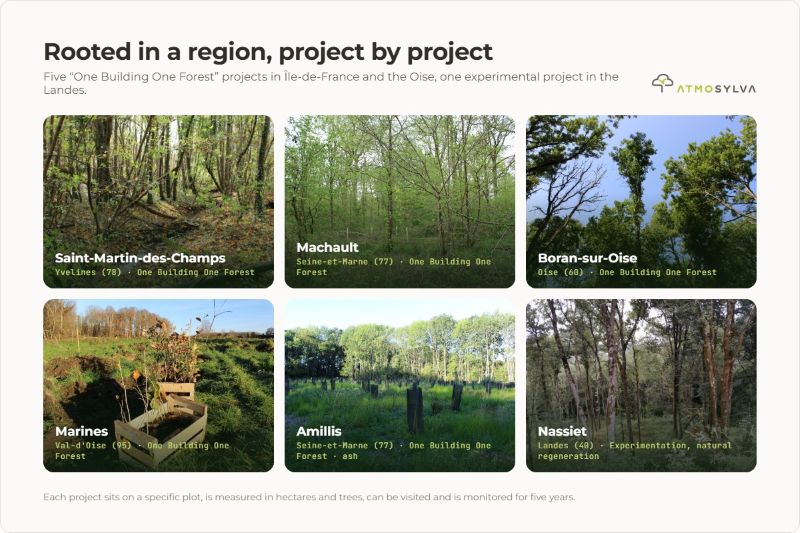
Taking root in a territory, project by project
3.1. Renewing the forest where you operate
A company working in a given region or département can choose to support a forest project there:
- financing tree planting or assisted natural regeneration;
- financing emission reductions certified under the Label bas carbone (the French government’s Low Carbon Label), from a nearby project.
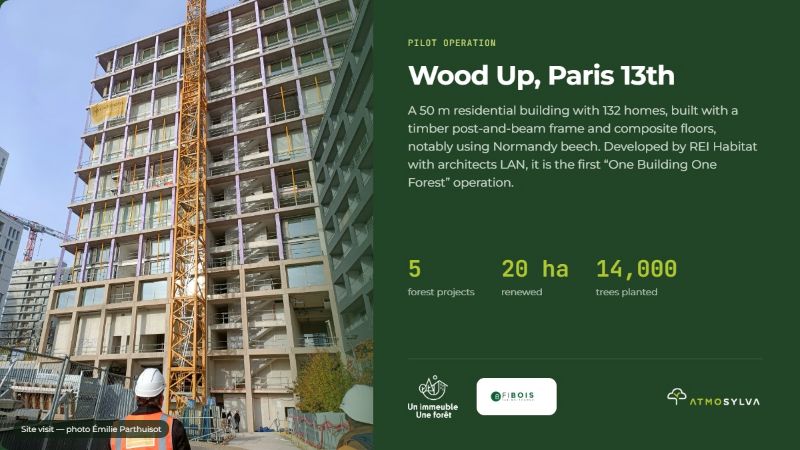
This is the principle behind “Un Immeuble Une Forêt” (One Building, One Forest), an initiative led by Fibois Île-de-France. It is aimed at construction and development stakeholders who use timber in their projects. For each property development, a forest renewal project is financed.
The pilot project is Wood Up, a 132-home building in the 13th arrondissement of Paris. According to Fibois, the initiative has launched five projects, covering 20 hectares and 14,000 trees planted.
Atmosylva supports several of these projects, financed by the developer REI Habitat, notably in Saint-Martin-des-Champs (Yvelines), Machault (Seine-et-Marne) and Boran-sur-Oise (Oise), among many other financed projects.
3.2. Supporting forest adaptation to climate change
French forests must adapt to a rapidly changing climate. This requires testing, observing and comparing. A company can choose to contribute to experimental projects.
Atmosylva supports several of them:
- in Nassiet (Landes), an experimental and natural regeneration project, for more resilient forests;
- in Marines (Val-d’Oise);
- in Amillis (Seine-et-Marne), a project addressing the decline of ash trees caused by ash dieback.
Supporting these projects means contributing to the knowledge the whole sector will need tomorrow.
3.3. Taking root in a sector
This approach is open to all companies, whatever their sector. Supporting a forest project means working with local players in the forest-wood sector: forest owners, managers and experts, nurseries, forestry contractors.
Regional interprofessional bodies, such as Fibois Île-de-France, connect these players with companies wishing to get involved.
3.4. Sharing knowledge
A forest provides services to an entire territory: water regulation, soil protection, biodiversity, landscape. These services directly concern local authorities and their residents.
Raising awareness of them is part of the commitment. At Atmosylva, every contributor receives a certificate and the project description sheet for the project supported. They then follow the project for five years, with at least three monitoring reports. Site visits and taking part in planting are possible.
On request, with dedicated organisation, we also offer educational visits for schools.
For a local authority or a company, this is an opportunity to talk about forests in concrete terms with its teams, clients or residents. Forest issues are still poorly understood. Seeing them on the ground often changes perspectives.
4. Standing out
The Produrable conference asked how to measure a company’s contribution to its territory. A forest project provides concrete answers.
It is located on a specific plot. It is measured in hectares, in trees, and in verified tonnes of CO2 when it is certified. It can be visited, and it can be monitored over time.
The regulations now set a baseline. Local anchoring makes it possible to go further, in a way that is visible and verifiable. That is what will make the difference.
Sources
- Code de la commande publique, articles L2112-2, L2112-3, L2152-7 et R2152-7 (Légifrance)
- Code de l'environnement, article L228-4, version en vigueur au 4 octobre 2026 (Légifrance)
- DAJ de Bercy, Les mesures commande publique issues de la loi Climat et résilience et de la loi Industrie verte, 23 septembre 2024
- Service-public.fr, Les critères environnementaux des marchés publics évoluent le 21 août, 18 août 2026
- Fibois Île-de-France, Pourquoi construire en bois
Fibois Île-de-France, Un Immeuble Une Forêt