
Low Carbon Label: voluntary or mandatory contribution and compensation?
Are you financing or considering financing a Label Bas Carbone forestry project? The decree of September 5, 2025 has profoundly revised the regulatory framework. From now on, at the time of withdrawing your carbon credits, you must declare how you intend to use them: contribution, voluntary compensation, or mandatory compensation. Each option corresponds to a specific type of communication and different regulatory obligations. In this article, we recap the process of an LBC project and present the principles of carbon communication depending on the company's choice and the stage of the project (before or after audit).
PART 1: UNDERSTANDING THE JOURNEY OF AN LBC CARBON CREDIT
1.1 From labelled project to verified carbon credit
The simplified journey:
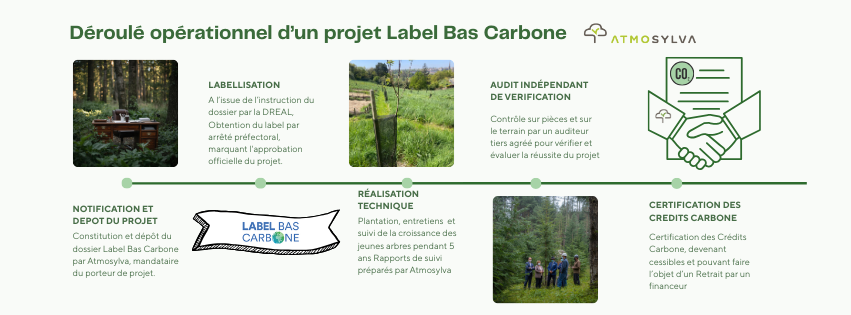
A Label Bas Carbone forestry project follows a multi-step process: administrative notification and labelling, technical implementation (planting, maintenance over 5 growing seasons), then an independent audit approximately 5 years after planting. It is only after this audit and prefectural validation that "potential tonnes of CO2" become verified carbon credits, which can be transferred to the project's financiers.
This distinction between potential and verified credits is fundamental for communication purposes: prior to the audit, any communication must mention the projected nature of the CO2 tonnes.
1.2 Transfer and withdrawal: two distinct stages
Transfer refers to the transfer of carbon credits. Since September 2025, credits can be transferred multiple times (unlimited transferability), which improves market liquidity.
Withdrawal is the stage at which the final beneficiary permanently uses the credits. It is a mandatory technical act that guarantees exclusivity: once withdrawn, credits can no longer be transferred or claimed by a third party. At the time of withdrawal, the beneficiary must declare their intended use: contribution, voluntary compensation, or mandatory compensation.
This usage declaration determines how the company will be able to communicate about its climate commitment.
PART 2: THE 3 VALORISATION OPTIONS
2.1 Carbon contribution
Carbon contribution is the default use of Label Bas Carbone credits. It consists of financing forestry sequestration projects without claiming to offset one's own emissions. This approach, favoured by ADEME, allows companies to highlight their commitment to the ecological transition in a factual manner in CSR reports, on the company website, or in institutional communications.
The decree of September 5, 2025 nonetheless imposes precise communication rules: the obligation to cite the financed project, to mention the parallel reduction efforts undertaken by the company, and a prohibition on implying that the financing is equivalent to a reduction in the company's own emissions. The wording must therefore be measured and framed to avoid any greenwashing.
2.2 Voluntary compensation: a stated commitment
Voluntary compensation allows a company to display a carbon target for a defined scope: an event, a product, a service, a site, or the company's own emissions. This option carries greater communicational commitment and is aimed at companies that have already implemented an ambitious reduction strategy.
Important note on corporate carbon: When the compensation concerns the company's overall emissions (rather than a specific product or service), the carbon credits can be recorded in the accounts as a deduction from residual emissions in the GHG balance or in extra-financial reporting. This is an accounting approach that does not mean the company becomes "carbon neutral" (which, according to ADEME, is a meaningless claim at the level of a single actor), but which allows the commitment to be recognised in regulatory or voluntary reports.
Climate and Resilience Act: If the communication concerns the carbon neutrality of a specific product or service, the law of August 22, 2021 (Article L.229-68) imposes strict obligations: a full GHG balance in accordance with ISO 14067, a quantified reduction pathway updated annually, and a prohibition on increasing unit emissions from one year to the next. These requirements are demanding but necessary to ensure the integrity of the claim.
The Label Bas Carbone decree also imposes enhanced transparency: precise specification of the exact scope being compensated, clear reference to the methodology used, and a systematic reminder of parallel reduction actions.
2.3 Mandatory compensation: regulatory compliance
The aviation sector is the primary party concerned: since 2024, operators of domestic flights must offset 100% of their emissions (Articles L.229-56 et seq.). Label Bas Carbone credits are eligible and even given priority to meet this obligation.
Other specific regulatory frameworks may impose compensation requirements in certain particular contexts (such as fossil fuel power plants under the law of August 16, 2022).
PART 3: COMMUNICATION BEFORE AND AFTER AUDIT
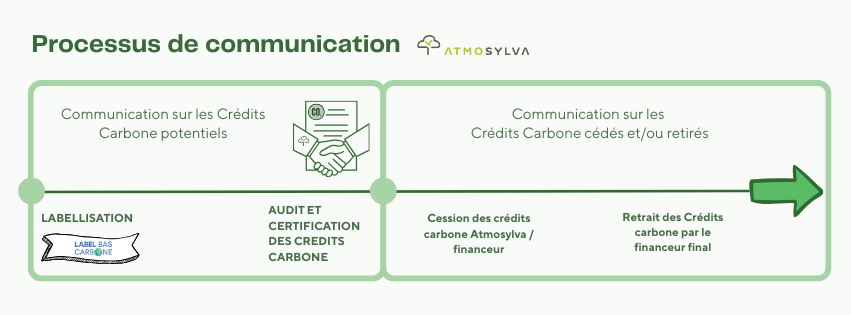
3.1 Before the audit: the mandatory provisional nature
Until the project has been audited and verified, all communications must explicitly mention the provisional nature of the CO2 tonnes by using the terms "estimated", "potential", "conditional", or the adverb "approximately". The decree also requires the addition of a sentence specifying that the definitive value will only be established after verification by an independent auditor and administrative validation.
This rule applies regardless of the intended use (contribution, voluntary or mandatory compensation). The objective is to prevent any misleading communication about tonnes that have not yet been certified.
3.2 After the audit: mandatory transparency
Once the credits have been verified, transferred and withdrawn, communications may refer to certified tonnes. Article 30 of the decree of September 5, 2025 nonetheless imposes principles common to all uses: explicitly citing the financed project, mentioning the reduction actions already undertaken by the company, and never implying that the financing is equivalent to a reduction in the company's own emissions.
These rules are designed to ensure transparency and to prevent the financing of Label Bas Carbone projects from becoming a simple greenwashing tool. Communications must remain proportionate to the actual commitment and form part of a broader climate strategy (measure, reduce, then contribute or offset).
The precise wording, sector-specific examples and regulatory nuances vary depending on the chosen use and the type of claim. This is why personalised support is often necessary to ensure communication is properly secured.
Would you like to ensure your climate communications are on solid ground?
Atmosylva offers a free, personalised consultation to:
- Analyse your situation and communication objectives
- Identify the most appropriate use (contribution, compensation)
- Support you in formulating your messages
Contact: contact@atmosylva.com