
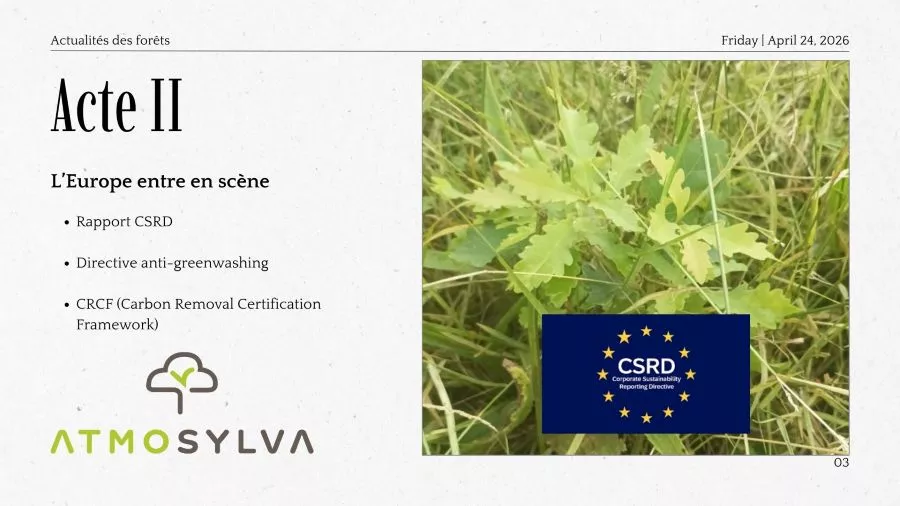
Act II: Europe takes centre stage
In Act I, we saw how the Low Carbon Label was launched in France in 2018 — well before Europe introduced legislation on corporate climate action. Today, the story is gaining momentum: Brussels is stepping in, with requirements affecting thousands of French companies. And the LBC, as a pioneer, finds itself perfectly positioned.
The CSRD: when the climate report becomes a legal requirement
Since 2025, large listed companies have been publishing their first sustainability report under the Corporate Sustainability Reporting Directive (CSRD). This standardised European reporting framework includes a dedicated climate section — the ESRS E1 standard — which requires, among other things, that companies document their voluntary carbon contributions.
The movement is gaining momentum: companies with over 1,000 employees and a turnover exceeding €450 million will be affected from the 2027 financial year, followed by listed SMEs in 2028.
And what about LBC in all this? Since September 2025, LBC carbon credits have been officially compatible with the CSRD. They may be mentioned in the ESRS E1 report as a verified voluntary contribution, traceable in the national public register. This is not a marketing ploy: it is documented, audited evidence, recorded in a statutory report. They do not replace an emissions reduction strategy — they are its credible and legally enforceable complement.
Europe bans greenwashing — France had already done so
In September 2026, the ‘Empowering Consumers’ anti-greenwashing directive will come into force across the European Union. It will ban unverified ‘carbon-neutral’ claims based solely on offsetting without a demonstrated reduction in emissions. This marks a major step forward for the integrity of carbon markets.
But France has not waited. As we saw in Act I, it legislated as early as January 2023 with the Climate & Resilience Act and its implementing decrees. The 2026 European directive harmonises across the continent what France has been practising for the past three years.
The LBC, whose credits are verified by an independent auditor and recorded in a public register, structurally meets the requirements that Europe will soon impose on everyone.
🔭 To be continued — The CRCF, the next major European text
In 2024, the European Union adopted the CRCF (Carbon Removal Certification Framework) Regulation, a European certification framework for carbon removals.
Its delegated act on permanent removals was published in February 2026 — but the specific methods for forestry and agriculture have not yet been published.
The LBC and the CRCF share similar methodological foundations, and recognition of equivalence is envisaged by 2027–2030. A new chapter is being written — we will return to this as soon as the texts are published.
📌 Key points
- The CSRD mandates statutory climate reporting: LBC credits have been included in ESRS E1 as a verified voluntary contribution since September 2025.
- The Empowering Consumers Directive, designed to combat greenwashing, will come into force across the EU in September 2026 — France has already been applying it since 2023.
- LBC is structurally aligned with what Europe will require: independent verification, a public register, and transparency regarding projects.
- The CRCF is the next European text to watch: forestry and agriculture methodologies are currently being developed.
In the next episode, the conclusion: the SBTi, carbon offsets and 2035 — companies that have realised that today’s forestry projects will be decisive tomorrow. Don’t miss the conclusion.