
Forest health: the latest IGN data
In 2026, IGN, the French National Institute of Geographic and Forest Information, published two reference documents on the health of French forests: the Atlas Cartographier l’Anthropocène and the National Forest Inventory Memento. Their data show that 9% of trees are now damaged and that tree mortality has more than doubled in a decade. IGN does not, however, conclude that French forests are in widespread decline, as these disturbances also reveal their capacity to adapt. Here we look at what the data show, and at how forests can be supported in this context.
1. The health status of forests is deteriorating
French forests continue to expand in area: they now cover 17.7 million hectares, or 32% of mainland France. Yet IGN data show that their health status tends to be deteriorating under the effects of climate change.
Over the 2021-2025 period, 9% of observed trees are damaged, which represents 197 million trees out of the 2,296 million inventoried. Of these, 50 million have died standing within the last five years. This figure is a minimum, since young trees and those already felled are not included in the calculation.
Damaged trees are found almost everywhere in the country, with strong geographical disparities: rates are highest mainly in north-eastern France.
How does IGN measure the health of a tree? The DEPERIS method, developed with the French Forest Health Department (DSF), records the presence of dead branches in the upper crown and the lack of twigs in broadleaves or of needles in conifers. A tree is considered to be in decline once it shows at least 50% foliage loss.
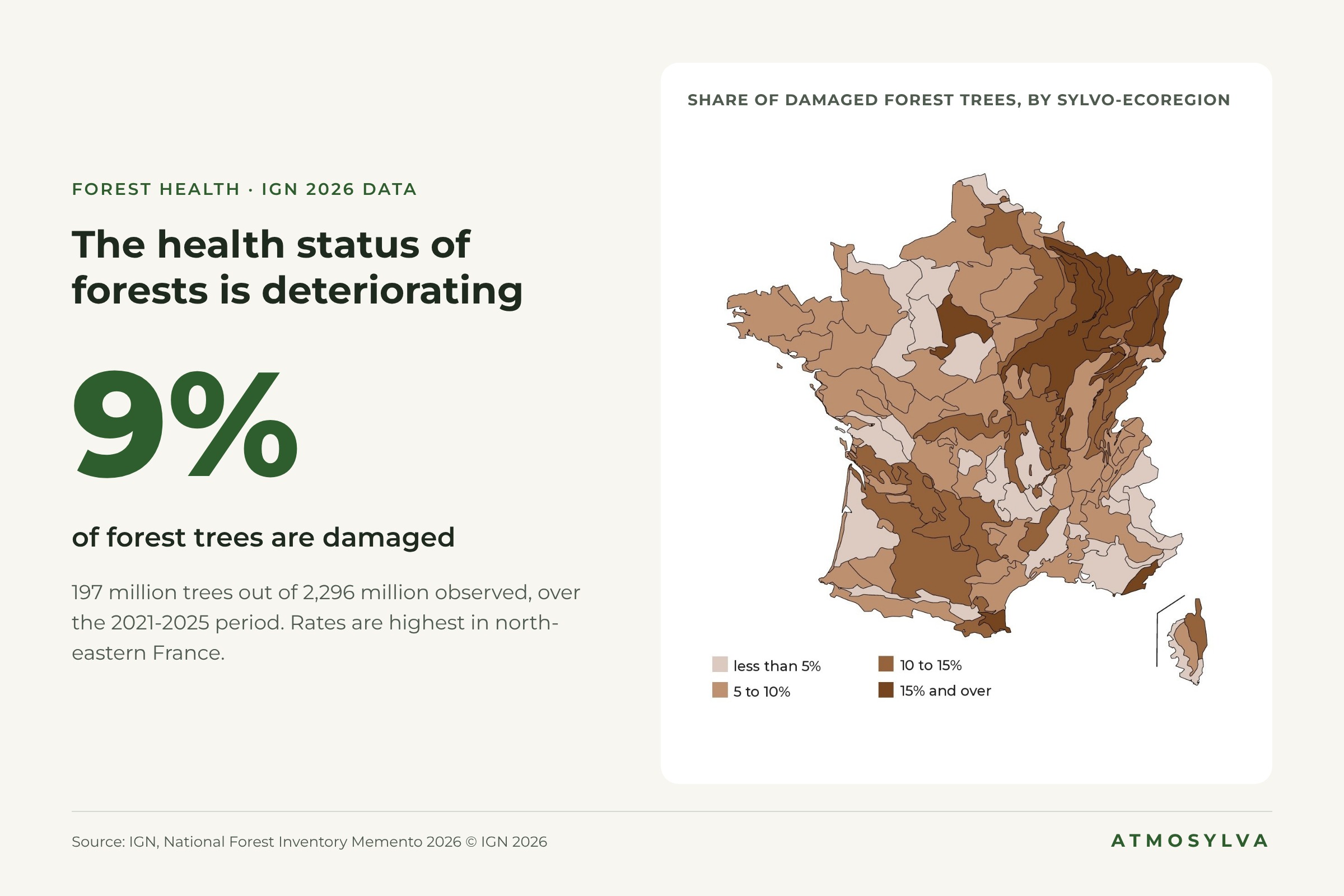
Source : IGN, Mémento de l'Inventaire forestier national 2026 © IGN 2026.
2. The most affected species
Four species are the most affected, each under the effect of an identified pest, disease or stress:
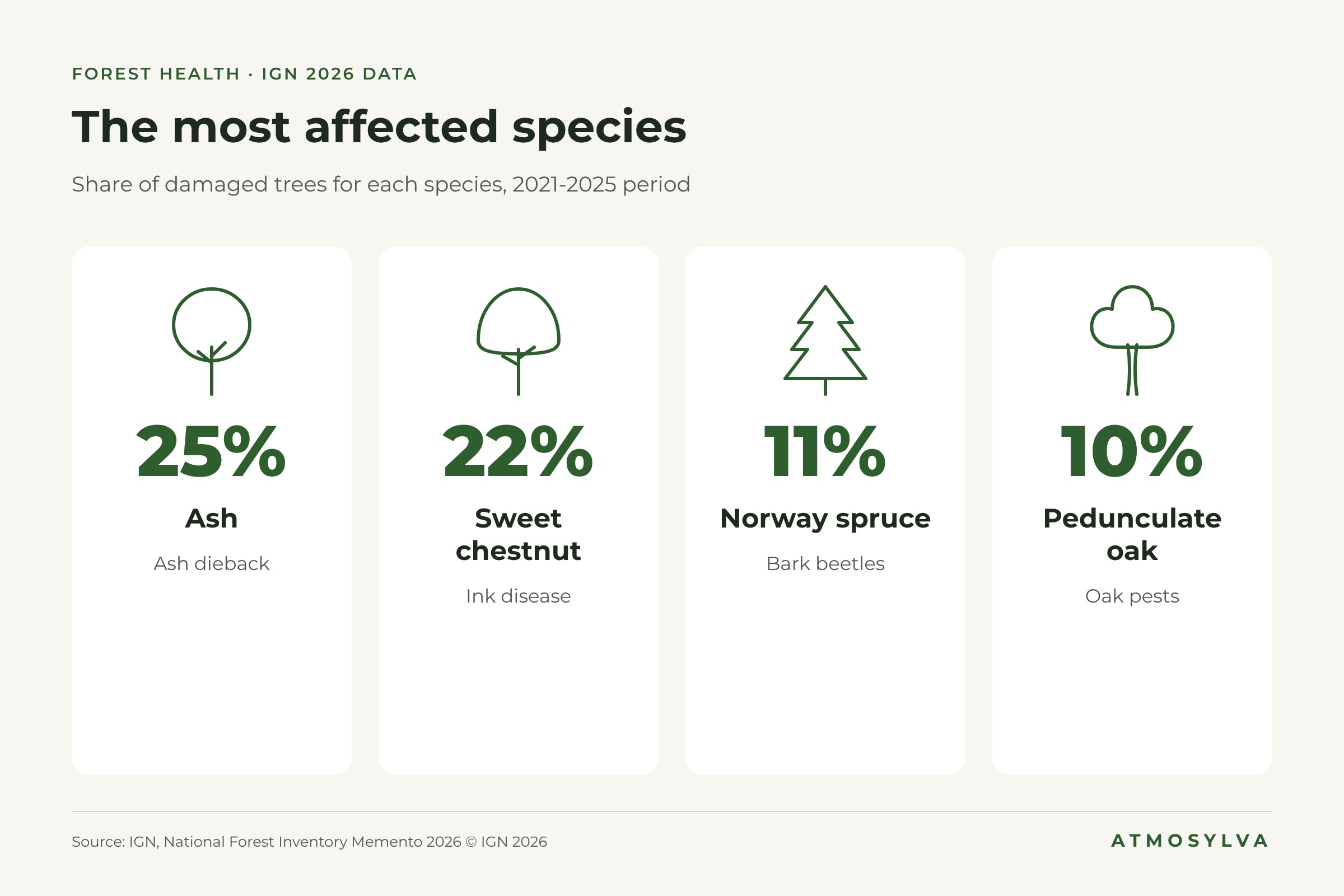
- ash, with 25% of trees damaged, affected by ash dieback, a fungus whose range now extends across the whole of mainland France;
- sweet chestnut, with 22% of trees damaged, affected by ink disease, which has been on the rise since the 2000s;
- Norway spruce, with 11%, hit by bark beetles, which proliferate during droughts and periods of high temperatures;
- pedunculate oak, with 10%, weakened by several oak pests that accelerate the decline of trees already under stress.
In terms of volume, spruce has become the species with the highest mortality, at 2.6 million m³ per year, ahead of sweet chestnut and ash. IGN estimates that 110,000 hectares of spruce and fir have been damaged by bark beetles, with the Alps, the Jura and the Ain now the most affected regions. Broadleaves are also affected, as their mortality rose from 4.5 to 12 million m³ per year between the last two decades.
3. Tree mortality
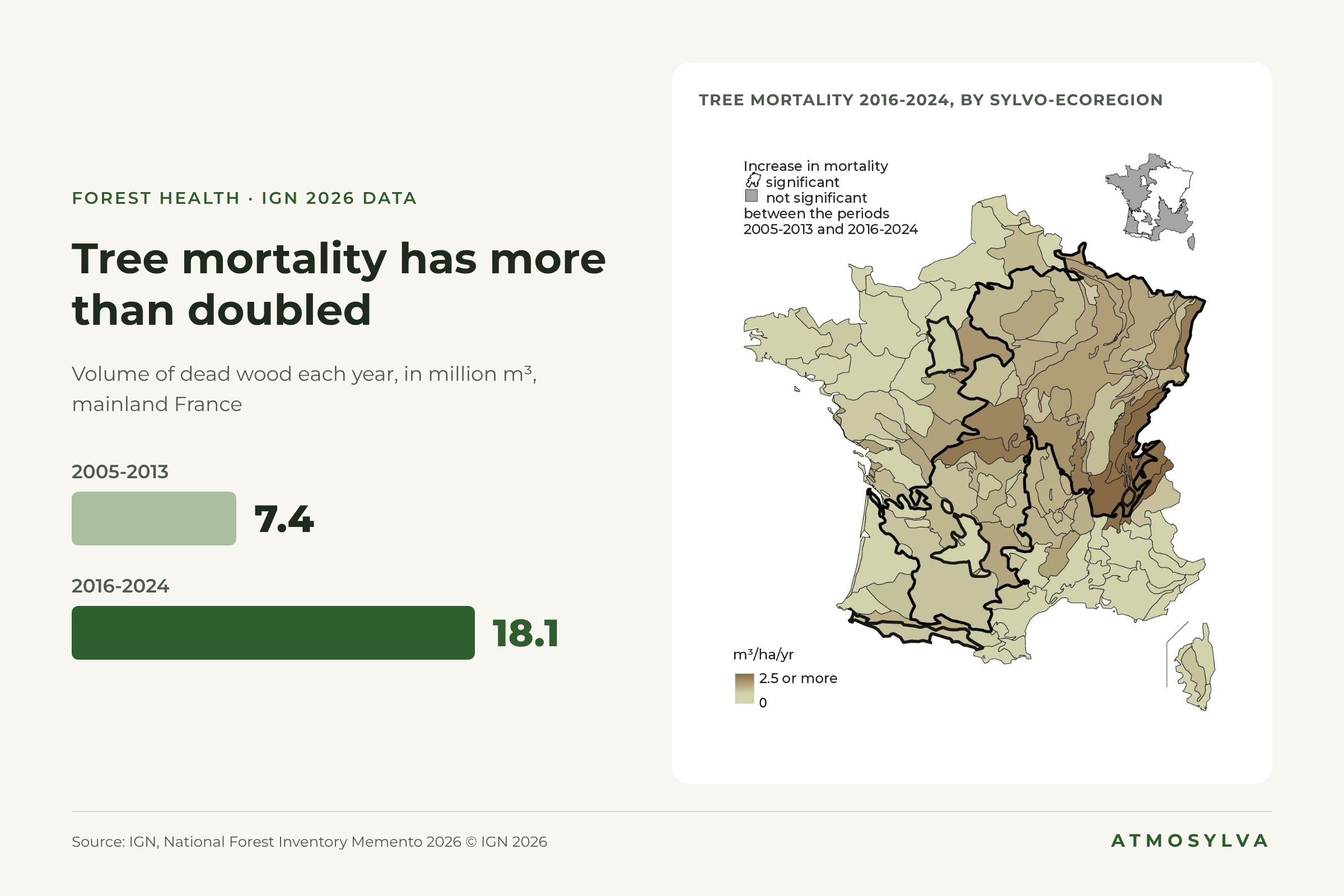
Annual tree mortality now averages 18.1 million m³ over the 2016-2024 period, compared with 7.4 million m³ over 2005-2013. It has therefore more than doubled in a decade, and this increase affects both pure stands and mixed-species stands.
According to Milène Gentils, head of the French Forest Health Department, three major threats account for most of this weakening:
- repeated water stress, as prolonged droughts, heatwaves and low rainfall weaken trees and make them more vulnerable to insects, as shown by the bark beetle outbreaks on spruce;
- invasive pests, which have no natural predators or parasites in Europe and become formidable pests, such as ash dieback, chestnut ink disease or the pine wood nematode, detected for the first time in France at Seignosse, in the Landes, in November 2025;
- overabundant ungulates, whose populations have increased tenfold for red deer and roe deer and twentyfold for wild boar since the 1970s, which hinders the growth of young trees and forest renewal.
These hazards build on one another: a forest damaged by a storm becomes more susceptible to pathogens, and repeated droughts increase the risk of fire. The growth of spruce and beech has also been clearly declining since the late 2000s.
4. Impact on forest carbon
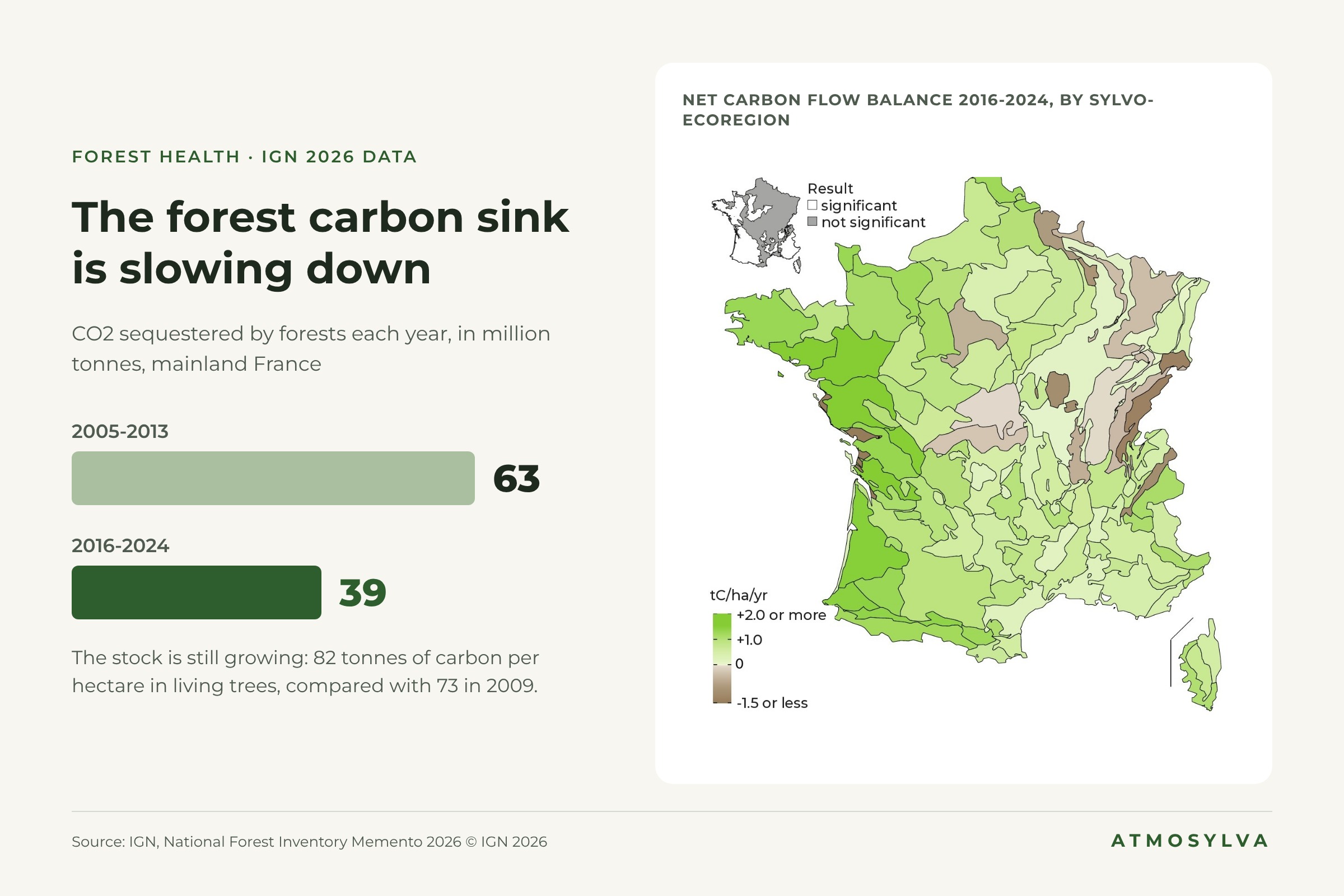
Forests continue to store carbon, but at a rate that has slowed markedly in a decade. The forest carbon sink fell from 63 to 39 million tonnes of CO2 per year between the 2005-2013 and 2016-2024 periods.
According to IGN, this slowdown is explained by three factors:
- rising mortality;
- declining biological production, down 8% per hectare in a decade;
- slightly higher harvesting, linked in particular to sanitary fellings.
The net balance of wood flows has therefore fallen by 52%, and it has become negative for spruce and ash. The carbon stock is nevertheless still increasing: each hectare of forest now holds on average 82 tonnes of carbon in its living trees, compared with 73 tonnes in 2009. In the north-eastern forests hardest hit by bark beetles, however, mortality and sanitary fellings already exceed biological production.
Restoring and diversifying stands therefore helps to preserve the forest’s capacity to store carbon.
5. Supporting forests in a changing climate
Forests are being transformed by the climate, and the challenge now is to support these transformations on the ground. Milène Gentils puts it this way: “One of the challenges is to support the transformation of forest ecosystems, by integrating climate projections into silvicultural choices and by promoting diversity, at every level.” She also points out that a renewal process is under way behind the observed mortality, with released areas gradually being recolonised.
Forest managers have several levers to achieve this. They can choose adapted species by taking into account climate projections and soil conditions, diversify stands through natural regeneration and planting, test new species in “future islands” (îlots d’avenir) and rely on diversity at every level, following the principle of the “mosaic forest”.
Caption: DEPERIS diagnosis carried out in the Yonne. Photo: Atmosylva
At Atmosylva, our projects are part of this approach:
- Diagnosing with foresters. Every project starts with preliminary studies carried out with forest managers and experts. We recently carried out a DEPERIS diagnosis in the Yonne, using the method IGN applies to measure forest health.
- Restoring. In Machault and Amillis, in Seine-et-Marne, we support forests affected by ash dieback. In Saint-Alban-d’Hurtières, in Savoie, and in Les Essarts-lès-Sézanne, in the Marne, we are restoring stands destroyed by bark beetles.
- Experimenting. In Marines, in the Val-d’Oise, a trial of Mediterranean oaks is being carried out with the CNPF, the French National Forest Ownership Centre, and the Nassiet project, in the Landes, combines experimentation and natural regeneration.
IGN data describe forests that need support to come through the changes under way. That is the purpose of the projects we develop with forest owners and managers, which you can discover on our projects page.
Sources
- IGN, Cartographier l’Anthropocène, Atlas 2026 (in French), part 3 “Are our forests in danger?”, including the interview with Milène Gentils, head of the French Forest Health Department.
- IGN, Mémento de l’Inventaire forestier national, 2026 edition (in French). © IGN 2026.
- IGN, interactive forest inventory, “Wood flows in French forests” (in French), inventif.ign.fr.
- French Forest Observatory (in French).