
Fires 2026: what makes a forest flammable
A season of extraordinary fires
As of 27 July 2026, nearly 68,000 hectares had been burnt in France, according to Effis, the European forest fire information system. The year 2022, which had previously held the record, had totalled 66,300 hectares over a full twelve-month period. What this season highlights is that a forest becomes flammable long before a spark spreads through it, due to the dryness of the soil and the condition of the tree stands.
Two events stood out this year:
On 9 July, 59 departments were classified by Météo-France as being at high to very high risk of wildfires. The previous record was 29 departments, in 2025.
- The geographical spread has widened to include Fontainebleau, the Drôme, the Var, Corsica, as well as the Gironde and the Landes. Historically, 75 per cent of the land area burnt in France has been concentrated in the Mediterranean region.
Nine out of ten wildfires are caused by human activity, and prevention remains the most effective measure in the short term.
However, a spark only causes a fire if the vegetation is in a condition to burn. This is the question we are addressing here: what creates conditions conducive to wildfires, prior to the outbreak of a fire?
I. Factors that make a forest prone to fire
Three categories of factors come into play, each with very different scope for action.
| Factor | Status |
|---|---|
| Climate | Human origin established. Collective action, long-term perspective. |
| Forestry Station | Soil, aspect, topography. Natural factors that cannot be altered. |
| Stand | Composition and structure. Actual scope for adaptation, under constraints. |
1.1 Historically dry soils
Météo-France produces the SWI (Soil Wetness Index), which measures soil moisture uniformly across the country: 0 for completely dry soil, 1 for saturated soil, and 0.4 as the drought threshold. The data dates back to 1958.
Agrometeorologist Serge Zaka (AgroClimat2050) has analysed this dataset for 2026. Three key findings:
- July 2026 broke a record. No July since records began has seen such dry soil conditions nationwide.
- The epicentre of the drought has shifted. An axis running across the country from the south-west to the north-east is where the lowest figures are concentrated, outside the usual Mediterranean areas.
- Regional disparities are widening. Since 1970, the severity of droughts has increased significantly around the Mediterranean. Brittany has so far remained relatively unaffected.
Three factors explain this trend:
- drier summers,
- increased water vapour in the atmosphere due to the heat,
- and more concentrated rainfall that runs off rather than seeping into the ground. It does not necessarily rain less, but the water is less effective at replenishing reserves.
1.2 Flash drought: a well-documented phenomenon
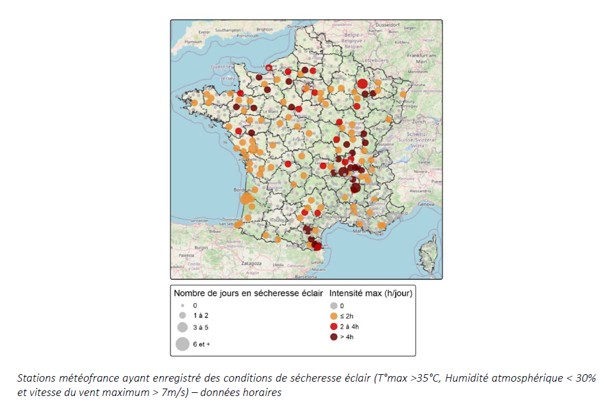
In July 2026, the Department of Forest Health (DSF) published a technical note on the impacts of the June heatwave. It outlines the sequence of events throughout the year:
- A rainy May had brought soil moisture levels back to near normal.
- The heatwave from 21 to 30 May dried them out abruptly.
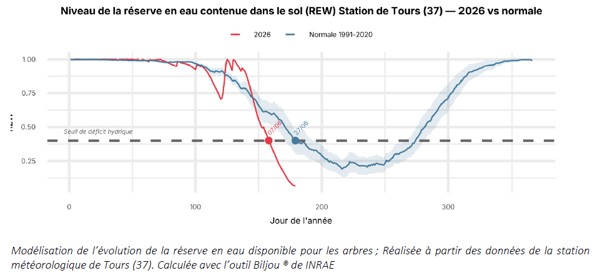
- By 1 June, soil moisture levels were equivalent to those usually seen in July. In the Tours region, the water deficit threshold was exceeded three weeks earlier than normal.
- The heatwave from 22 to 27 June pushed temperatures above 40 °C in the west of the country.
We refer to a flash drought (or the ‘hairdryer effect’) when three conditions occur simultaneously:
| Parameter | Seuil |
|---|---|
| Temperature | > 35 °C |
| Air humidity | < 30 % |
| Wind | > 7 m/s (25 km/h) |
The air then ‘draws’ water from the plants much more quickly than usual, and the tissues dry out immediately, without the soil being able to compensate.
The DSF notes that these thresholds are almost identical to those used by the DFCI to assess fire risk, the ‘rule of three 30s’: over 30 °C, less than 30 per cent humidity, and wind speeds of over 30 km/h.
1.3 Site and stand: why two forests do not react in the same way
Given equivalent weather conditions, the differences come down to five factors.
Station-related:
- Soil water reserve. The amount of water that the soil can store and release to trees. A shallow soil layer over bedrock depletes quickly; a deep soil layer provides several weeks’ worth of water. The DSF models this using INRAE’s Biljou® tool.
- Local conditions. Aspect, slope, altitude, proximity to a watercourse. A windy south-facing slope does not behave in the same way as a valley floor.
Related to settlement :
- Root depth. The DSF issues a warning regarding plantations less than 5 years old: if surface drought persists, there is a high risk of mortality, as the root system is not sufficiently developed to reach water at greater depths.
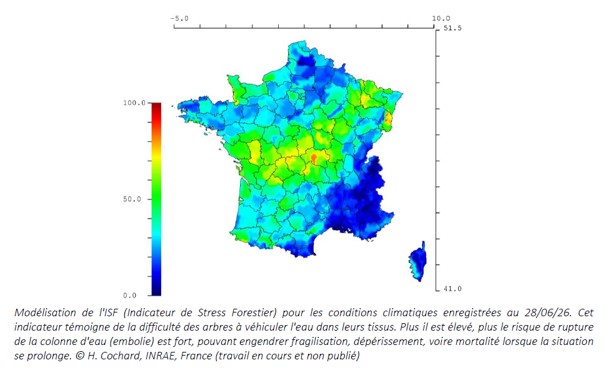
- Water circulation within the tree. Water rises in a continuous column from the roots to the leaves. If the pressure becomes too high, this column breaks: this is known as embolism. INRAE models this risk using the Forest Stress Indicator, which, at the end of June 2026, highlighted stressful conditions in the Pays de la Loire, Centre-Val de Loire, Auvergne and Grand Est regions.
- Composition and health status. The Sustainable Management Indicators (French Forest Observatory, July 2026) show a reasonable average level of diversity, with 5.2 species per plot, but a high level of concentration at national level: half of the hardwood volume consists of oaks, and 80 per cent of the softwood volume is accounted for by five species.
The previous state of the forest has a significant impact. Annual mortality has risen from 8.5 to 15.2 million m³ between 2005–2012 and 2014–2022, an increase of 125 per cent over ten years. The proportion of deciduous trees with severe foliage loss has risen from 2.2 per cent (1997) to 15.3 per cent (2025).
II. The result: a growing trend towards combustibility
This is the most significant point in the DSF’s report:
The drying out of foliage caused by flash drought, in addition to that of the herbaceous layer, increases the flammability of even deciduous stands.
An oak or beech forest, which normally withstands fire well thanks to its internal moisture content and canopy cover, can therefore become combustible under conditions where it was not previously so.
However, not all stands become equally flammable: a Mediterranean pine forest remains structurally more flammable. But the gap narrows when extreme conditions become widespread, which explains the geographical spread observed in 2026.
The DSF highlights a delayed effect: weakened trees become vulnerable to secondary insect pests (bark beetles, Asian longhorn beetles, jewel beetles), with potential mortality by the end of the season and an accumulation of standing deadwood.
III. Forestry measures to mitigate these favourable conditions
3.1 Managing the ongoing dieback
The DSF makes three immediate recommendations.
Do not confuse a reaction with dieback. Leaf desiccation, reddening and premature leaf fall are often defence mechanisms: the tree sacrifices leaf area to limit its water loss. These ‘should not be mistaken for tree mortality’.
Have a diagnosis carried out by a network correspondent-observer or any other forestry professional trained in the Deperis diagnostic method. Reacting too quickly leads to costly and unnecessary decisions.
Postpone certain felling operations. In stressed stands with less than 10 per cent mortality, postponing felling avoids additional stress and maintains the forest environment, that is, the microclimate created by the canopy. This point is directly linked to the issue of fires: a continuous canopy preserves shade and moisture on the ground, and limits the drying out of the herbaceous layer.
3.2 Designing forests for the climate to come
Some factors cannot simply be put up with. They need to be addressed, one site at a time. This is the aim of the projects developed by Atmosylva.
Regeneration through planting. Diversifying tree species spreads the risk across species that do not respond to the same stressor or at the same time. The choice is based on the soil, aspect and the climate projected for the next 30–50 years. Soil preparation determines root establishment and, consequently, access to water during dry periods.
Supported natural regeneration. The seedlings already in place have grown under local conditions and have well-established root systems. Clearing a path for them and protecting them is less expensive than planting new trees, and often yields better results.
Conversion to a continuous-canopy uneven-aged stand (SMCC). Allowing trees of different ages and sizes to coexist, without ever leaving the ground bare, makes it possible to:
- to maintain shade and soil moisture at all times;
- to limit evapotranspiration and the drying out of the herbaceous layer;
- to ensure continuous regeneration beneath the canopy;
- to spread the risk over time rather than concentrating it on a clear-cut.
Ecosystem services projects. Beyond carbon, forest regeneration and the restoration of aquatic habitats within forests (watercourses, wetlands, riparian forests) are eligible for funding on a per-hectare basis. These projects address issues relating to water quality, biodiversity and water regulation, which have a direct impact on the resilience of the mountain range.
A forest cannot be made fireproof. But between a stand of trees that survives a summer like that of 2026 and one that does not, there is a series of technical decisions taken years earlier.
Sources
- Effis (European Forest Fire Information System), data as at 27 July 2026
- Météo-France, Forest Weather, July 2026
- Forest Health Department, DRAAF Centre-Val de Loire, Technical Information No. 73, June 2026 heatwave: potential impacts on forests, July 2026
- French Forest Observatory (IGN), Indicators of Sustainable Forest Management in France, 2025 edition, July 2026
- Serge Zaka (AgroClimat2050), analysis of SWI Météo-France Open Data, July 2026
- INRAE: Biljou® tool; Forest Stress Indicator (H. Cochard, work in progress)